
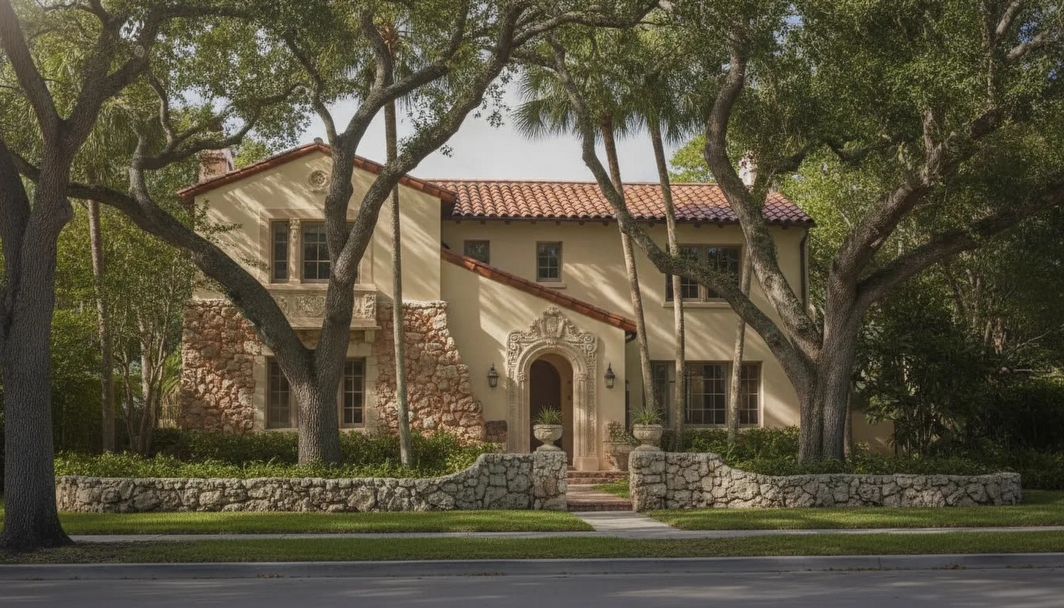
Coral Gables Historic Home: Review Checklist
A Coral Gables historic home is not just an older house with a clay-tile roof. Local designation can change which exterior work needs review before a permit, while a house that only looks historic may have a different path. Before you offer, confirm the address, the review that applies, and whether your renovation plan still works.
Talk with The Maya Vander Group before you write an offer on a designated or design-reviewed house.
What makes a Coral Gables historic home different?
Age and style are clues, not proof. Coral Gables published its first historic-preservation ordinance in 1973, and the city still reviews changes to locally designated landmarks and properties in local historic districts. A Mediterranean house from the 1920s can be individually designated, part of a district, listed only in a national register, or subject to ordinary design review with no local historic status at all.
The city's guide, Preserving Our Past, says a property generally must be at least 50 years old. It also needs architectural, aesthetic, or historical value to qualify for the Coral Gables Register of Historic Places. Any person with specific information may nominate a property. The Historic Preservation Board decides, and an ordinance records the designation.
That process matters to a buyer because designation is not a private label. It stays in effect while the property keeps the qualities that made it significant. A seller's brochure cannot settle the question. Ask for the designation ordinance, a recent determination, or written confirmation from the city's Historical Resources staff, then match that record to the legal address.
Ask for the record, not the story. A house can look historic and still be undesignated. Another can sit in a district even when the facade has been altered.
Which review applies before you renovate?
Two city reviews are easy to mix up, and they answer different questions. Local historic review asks whether proposed work respects a designated property. The Board of Architects reviews design across the city, whether or not the house is historic.
| Question | Local historic review | Board of Architects |
|---|---|---|
| What it covers | Local landmarks and district properties. | Design review across the city. |
| Typical trigger | Exterior permit work and some variances. | New homes, additions, pools, and roofs. |
| Who reviews it | Preservation staff or the Preservation Board. | The Board of Architects on Thursday mornings. |
| What to collect | Status, prior certificates, and open filings. | Prior approvals and any approval still required. |
The Board of Architects looks at color, materials, windows, proportion, and the order of the design. A typical permit needs preliminary and final board approval before the city issues it. The board can also hear an appeal of the City Architect's decision. A tree survey and tree-protection plan are required with many of those submittals and with demolition permits.
Historic status does not replace that design review. A designated house may need both a preservation decision and an architectural-board decision before the same addition can be permitted. Build both timelines into the closing date instead of assuming one approval covers the other.
When does a Certificate of Appropriateness apply?
The city requires a Certificate of Appropriateness before most exterior work on a local landmark or a property in a local historic district. The certificate confirms that the specified work was approved. The city also requires it before most building permits and before a variance on that property. Some maintenance does not need this review, so do not guess from a contractor's habit.
The city's published guide separates the work by impact:
- Minor work can include re-roofing, painting, and repairs in kind. Staff may handle those requests.
- Substantial work can include an addition, a demolition, or a major exterior remodeling. Those proposals go to the Historic Preservation Board for a public hearing.
- A Special Certificate of Appropriateness is the path when the owner also needs a variance so an addition or change can keep the historic setting.
Staff meet for plan review on Mondays and Wednesdays from 9 a.m. to noon, and owners can email hist@coralgables.com to schedule. The Historic Preservation office is at 234 Minorca Avenue. Confirm the current deadline calendar before you promise a contractor a start date.
Interior remodeling is generally not part of this review. The city guide makes an exception when the owner wants ad valorem tax relief for interior work. It also names a few public interiors, including the Biltmore Hotel lobby and tower suites. A private house renovation is usually an exterior question, but a tax application can pull interior work into the file.
How should you read the renovation rules?
Approved work is judged against the Secretary of the Interior's Standards for Rehabilitation. The National Park Service publishes those standards for rehabilitation projects, and Coral Gables uses them to decide whether a design change is appropriate. They are performance standards, not a paint chart.
Five rules explain most buyer disputes:
- Keep the features that define the house, and avoid removing materials or spaces that create its character.
- Repair a deteriorated historic feature before you replace it. If replacement is necessary, match the design, color, texture, and, where possible, the material.
- Do not invent a past that never existed by adding conjectural details or pieces taken from other buildings.
- Put new additions and exterior changes where they do not destroy historic material. New work should be compatible in mass, size, and scale, and it should be distinguishable from the old.
- Design an addition so it could be removed later without harming the essential form of the house and its setting.
Those rules change the cost of a plan, not just its appearance. A buyer who wants a two-story glass addition on the street facade, new window openings across the front, or a sandblasted finish should assume a redesign. The city guide says changes are allowed when they fit the architecture. An addition on a secondary facade is a common example of work that may be approved. A street-facing change that alters the character is a different case.
Ask the seller for every prior certificate, staff letter, and board order. Approved plans show what the city already accepted. An expired approval, or a plan that was drawn but never filed, is not the same thing. If the work in progress does not match the approval, treat the difference as an open permit issue.
What can designation change about cost and timing?
Designation itself does not raise the assessed value. The city guide says properties on the Coral Gables Register are not taxed more only because they are designated. There is also no extra fee solely because a property is historic. Permit requests for designated properties go to the Historic Preservation office first, and staff coordinate with Building and Zoning.
The cost usually sits in the work, not in a special tax rate. Matching a clay-tile roof, repairing original windows, or redesigning an addition can cost more than a standard renovation. The hearing path can also add weeks. Put the review into the contract as a dated condition if the offer depends on a specific addition, demolition, or variance.
There is a possible offset. If improvements are approved through the certificate process, the owner may apply for a local tax incentive. The city guide describes a ten-year exemption on the ad valorem taxes attributable to the value of those improvements, from both the city and Miami-Dade County. The work must follow the Secretary's Standards, and the owner must sign a covenant to maintain the improvements for the exemption period. It is not an exemption on the whole tax bill, and it is not automatic.
Price the plan you can actually permit. A lower purchase price is not a bargain if the only version of the house you want cannot be approved.

How do you check one address before offering?
Use the same sequence on every finalist so a charming street does not skip the record. The Coral Gables houses for sale guide can help you compare lots and condition. This list answers the historic-review question that guide does not.
- Match the address. Confirm the legal description, lot, and any guesthouse or addition that is part of the sale.
- Ask whether it is on the local register. Request the designation ordinance or written staff confirmation. Separate an individual landmark from a house that contributes to a district.
- Read the open file. Collect prior certificates, board orders, violations, and any application that is still pending.
- Test your plan in writing. Describe the roof, windows, addition, demolition, or variance you actually want. Ask which path applies: staff review, a board hearing, or no certificate.
- Check the other reviews. Add Board of Architects timing, a tree survey if you will build or demolish, and flood questions. The separate Coral Gables flood-zone house guide covers elevation and flood insurance.
- Price the allowed version. Get a contractor estimate for repair in kind and for the addition you hope to build. Then decide whether the contract needs an approval contingency.
A condominium inside a designated building needs a second file. Association minutes, reserves, and inspection history still control the building's money. Use the Miami luxury condo due-diligence guide, the Florida condo reserve guide, and the SIRS deadline guide for that review. Historic approval does not replace a reserve study or a milestone inspection.
Window and roof condition can also change insurance. The Florida condo insurance guide is a useful companion when the property is a condominium and the carrier asks about updates. For a house, ask your insurer how original windows, an older roof, and any required repair-in-kind affect the premium before you waive inspection.
Where does this fit a luxury search?
The live Coral Gables luxury real estate guide covers neighborhoods, home types, and the broader buying decision. Keep that page for the area. Use this checklist when one house may carry a designation or when the renovation is the reason you are buying.
Luxury buyers often arrive with a plan already in mind: a larger kitchen, a pool, a new primary suite, or a cleaner street facade. In Coral Gables, that plan can be compatible and still need a hearing. International buyers should leave time for the same review even when a representative attends the hearing. The board evaluates the work, not the buyer's travel schedule.
Compare three numbers on the same sheet. Record the asking price, the cost of repairs the city is likely to require in kind, and the cost of the addition only if staff or the board has accepted a comparable design. If the third number depends on a variance, treat it as uncertain. A Special Certificate of Appropriateness is an application, not a promise.
For a wider shortlist, start with the Miami communities guide and then return to the address-level questions here. A historic house can be the right purchase when the review file is clean and the plan is realistic. It is a poor fit when the offer assumes a street-facade change that the standards discourage.
Talk with The Maya Vander Group to review the designation file and the renovation limits before you offer.
Frequently asked questions
Does every older Coral Gables house need a Certificate of Appropriateness?
No. The certificate applies to a local historic landmark or a property in a local historic district before most exterior work, a building permit, or a variance. An older house that is not on the local register follows the ordinary permit and Board of Architects path. Confirm the address with the city rather than relying on the year it was built.
Can I renovate the interior of a designated house?
Usually, yes. The city guide says interior remodeling is not reviewed unless the owner requests ad valorem tax relief for that interior work, or the interior is one of a few specifically identified public spaces. Exterior changes that need a permit are the ordinary review.
Will designation raise the property tax?
Not by itself. The city says local designation does not increase assessed taxes solely because the property is listed. A separate, optional program can exempt the added value of approved improvements for ten years after a covenant. It does not exempt the existing assessment.
How long can a substantial change take?
There is no single number of days. Minor work such as in-kind repair may be handled by staff. An addition, demolition, or major exterior remodeling goes to the Historic Preservation Board, and Board of Architects approval can be a second step. Ask staff for the current deadline and hearing dates before you set a closing.
What should I collect from the seller?
Ask for the designation record, prior certificates and board orders, open applications, approved plans, permit history, and any covenant tied to a tax exemption. Then write down the exact exterior change you want and ask which review path it requires.
Ready to Explore Luxury Real Estate in Miami?
Don't miss opportunities in one of Florida's most desirable markets. Contact Maya Vander today for exclusive access and personalized service.


